Last week’s midterms were a bad night for Republicans. I will not pretend otherwise. Democrats flipped the House and the Senate, and they walk into January with subpoenas, gavels and grievances. Anxiety about a revenge-minded Congress is understandable — and a poor reading of the system. The founders built friction into the machine on purpose, and that design still holds.
The veto math they cannot wish away
A bill that reaches the President’s desk dies with his veto unless two-thirds of each chamber override him. With all seats filled, that is 290 House votes and 67 Senate votes. Democrats do not have those numbers, and they are not close.
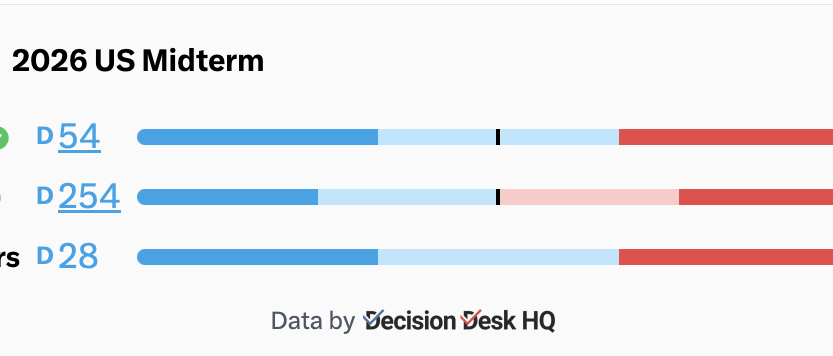
As of today, the Associated Press had Democrats at 254 House seats and Republicans at 162, with 19 races still uncalled. Even a sweep of the rest leaves them short without a large Republican bloc. In the Senate, Democrats hold 54 to Republicans’ 44, with Alaska and Mississippi still counting, USA TODAY reported, citing AP. At 54 they need 13 Republican senators for an override; at 56, still 11.
Overrides are rare. The Senate’s historical table lists 2,599 presidential vetoes since 1789 and only 112 overrides — roughly four in a hundred. In his first term, Trump issued 10 vetoes; Congress overrode one, the fiscal 2021 defense authorization, a bipartisan national-security bill. A partisan revenge package will not clear that bar.
Referrals are not handcuffs
Congressional “criminal referrals” sound dramatic. They are not indictments. They are recommendations. The Justice Department decides whether to charge anyone.
In June 2022, the department declined to prosecute Mark Meadows and Dan Scavino after House contempt referrals over January 6 subpoenas, the Associated Press reported. Steve Bannon and Peter Navarro were charged; those two were not. In 2012, after the House held Attorney General Eric Holder in contempt over Fast and Furious documents, the Justice Department under President Obama also declined a criminal case. Congress can investigate. It cannot force a prosecution the department will not bring.
Subpoenas compel documents and testimony, but enforcement hits the same wall. Criminal contempt goes back to the Justice Department, which can decline. The other path is civil litigation, and that takes years. The House sued in 2019 to enforce its subpoena of former White House counsel Don McGahn; the fight ended in a 2021 deal, about two years later. (It cuts both ways: a Republican House held Attorney General Merrick Garland in contempt in June 2024 for withholding the Biden–Hur interview audio, and DOJ declined to prosecute.) Subpoenas buy hearings, and posts and headlines, not outcomes.
What they can do — calmly stated
Honesty matters, or reassurance sounds like coping. A Democratic House can run oversight, stall appropriations and play shutdown politics. A Democratic Senate can bottle up nominations. The House can impeach by simple majority. Removal still requires two-thirds of the Senate — 67 votes — the same wall that protected Bill Clinton and later Trump himself. Those tools can harass. They cannot rewrite immigration law, pack the Court by statute, or force a signature the President will not give.
Reagan never had both chambers
If divided government were a death sentence, Ronald Reagan’s presidency would be a footnote. Republicans held the Senate for his first six years; Democrats held the House for all eight. He never had a unified Republican Congress. He still signed the Economic Recovery Tax Act of 1981 and the Tax Reform Act of 1986, the latter with a Democratic House. Presidents who know what they want, and who can peel off enough votes, still govern.
The voters who come back in presidential years
Midterm and presidential electorates are not the same people. Census figures put turnout at 61.3 percent of the voting-age citizen population in 2020 and 52.2 percent in the 2022 midterms — a nine-point drop. Millions who sit out midterms return for the presidency.
That matters if Congress turns governance into spectacle. In 1998, House Republicans pushed Clinton impeachment proceedings into the midterm season and expected a wave. Democrats gained five House seats instead, the first presidential-party House gain in a midterm since 1934. Voters who saw score-settling punished the pursuers. That is no guarantee every investigation backfires — only that presidential-year voters notice overreach, and get the last word.
The bottom line
Yes, the red team lost. No, that is not a blank check. Democrats lack the votes to override vetoes. Their referrals do not compel the Justice Department. Their impeachment majorities do not equal removal. Reagan governed eight years without ever controlling both chambers, and the same Constitution that limited him now limits them.
So, Mr President, use the veto. Defend the nominations that matter. Keep governing. Refuse to confuse cable drama with lost power. The more any investigation looks like a partisan hunt instead of a serious inquiry, the more likely those presidential-year voters are to return in 2028 ready to settle accounts of their own.
Checks and balances are not a slogan. They were instigated by wise men of vision. They may rescue us today.